Vibe rot
Refreshments are available in the lobby
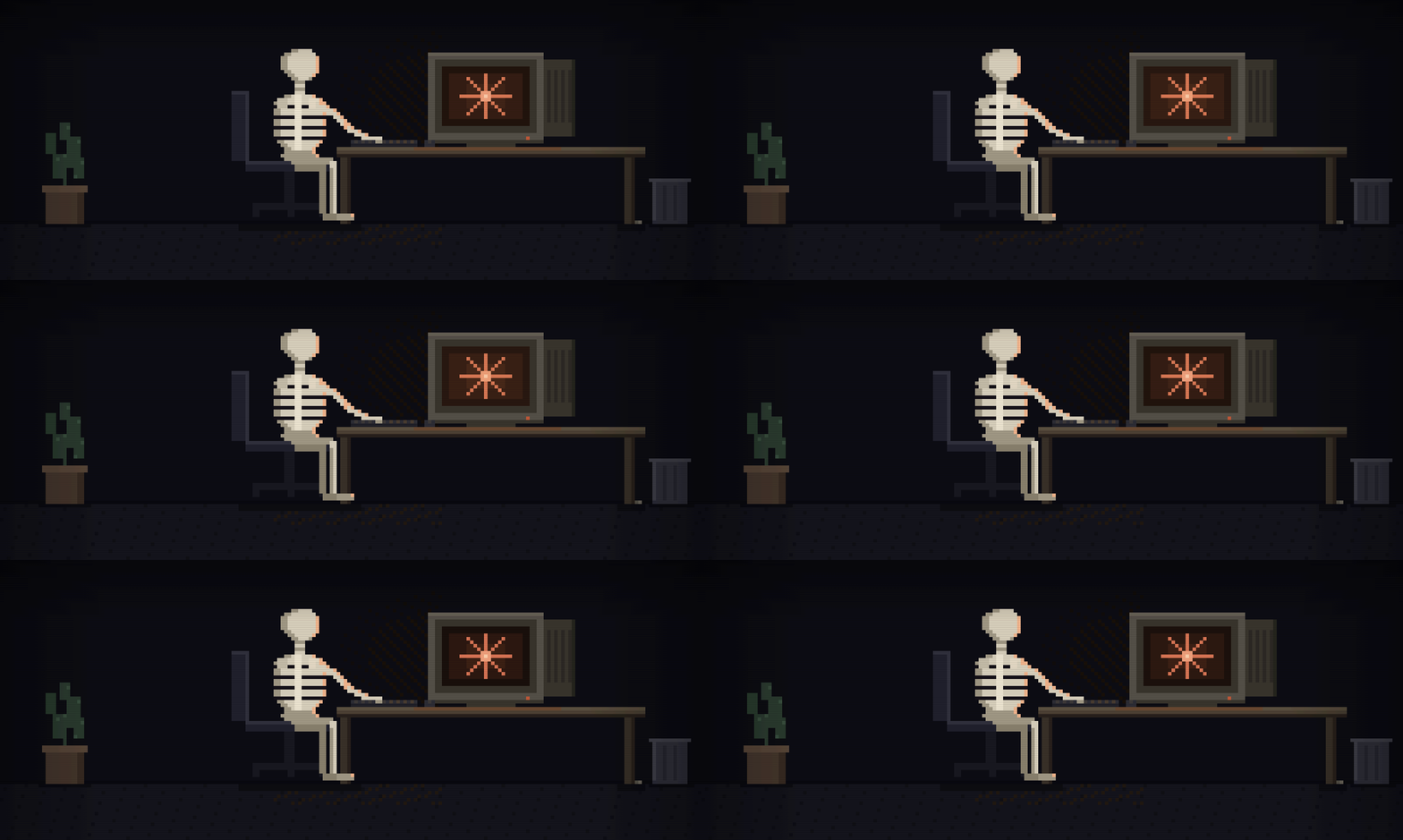
I’ve been vibe coding since January this year, with Claude Code’s desktop app being my daily driver for work since March. We are barely halfway through the calendar, and it’s already been a year for the books. I’d like to reflect on that.
And strap in. This post is part-rant and partly an exercise in self-soothing.
It’s become clear that today’s LLMs are incredible tools, allowing us to achieve way, way more than has ever been imaginable until now. Our recent past has become almost unrecognisable; yesteryear’s paradigms and expectations for software development now seem comically dated. It’s a rare situation where the hype was, if anything, too restrained.
The heatwaves are telling me it’s July now – and the dust has yet to really settle; the situation is developing much faster than organisations (with all their politics and inertia) are able to stay on top of.
These days it feels like every week – practically every day – we’re witnessing the genius work machine transform before our eyes: research tools, agentic loops, recursive self-improvement, flexible (and tasteful!) design tools. And all of this change compounds. Just this past month, AI has been solving decades-long open maths conjectures like they were sudokus. Even contemporary math god Terence Tao seems impressed.
At times, it can feel like our species is stuck on a rollercoaster – we’ve lost the sense of controlling our own destiny; the best we can do is hold on tight and try to keep our wits about us.
With all this drama happening around us, this post is really just like the interval that lands at the dramatic climax of a play. A brief reprieve, a moment to reflect, ponder on what comes next and catch our collective breath (and to hunt down those snacks in the lobby).
Out with the old
The old software development lifecycle is hanging on by a thread; more of a traditional ceremony now than a vital part of everyone’s weekly routines. Two week sprints are like an eternity now. New tools keep dropping to usurp this, almost all of them built into your chat.
The old roles are looking pretty dead, too. I’ve seen managers, PMs and even software developers spin up rich, interactive prototypes in just a few hours of tinkering. What used to take a trained specialist days has now collapsed into the abyss (as has Figma’s stock price). All we do now is tinker and produce. Someone called us AI slop cannons and there’s a non-zero amount of truth to that.
Looking back, we can hardly believe our good fortune. The tech sector has enjoyed maybe two or three decades of relative stability:
- We knew who did what role (and we knew how to stick to that)…
- We had a reasonable sense of what our career trajectory might look like…
- We knew what things were worth…
- We felt we had a decent shot at a high quality of living…
Wake up
You fell asleep. It’s still 2026.
…
The old status quo looks comically dated now. And nobody will really mourn us; next to lawyers, we were poster children of the slow, ivory-tower genius class that arguably earned far too much money when compared with teachers or nurses.
For everyone else, our loss is their gain. Software will surely become easier to use, effortlessly customisable, instantly generated on-demand and essentially free. Some people say code may flow as easily as water or electricity, as just another public utility.
As of July 2026, software developers are still stuck in limbo. The new world I’ve been describing hasn’t fully manifested just yet. And so we’re coding away faster and more prolifically than ever before.
Nobody I know writes lines of code by hand anymore. Some of them have stopped even checking their generated outputs if everything seems to be working.
I can see why; the machine is visibly getting better. Anthropic suggested Claude Code would surpass human-level engineer output before the end of 2026. Given the speed and trajectory of this product class, there’s little reason to cast any doubt on this claim.
The second criterion is writing code that another engineer can understand and build on. Here the gap between humans and AI persists, but is closing fast. There isn’t full consensus among staff at Anthropic, but many believe that the Claude-written code was still worse in quality than human-written code at Anthropic in late 2025, and is roughly at parity today. We expect it to be better within the year.
Where the rot is
What I’d like to highlight is that there’s something unexpectedly acerbic about this new way of working. I’ve been trying to put my finger on why:
- Our hard-won knowledge of software engineering came from willingly putting ourselves through an intense grind. The knowledge was esoteric, closely-held and challenging to gain.
-
Coding well and building flexible, powerful software was a display of skill. We were held in high esteem for what we could build, and with that came a sense of dignity – dignity, which has been rapidly eroded.
- Pride has also left the equation. Coding well was a craft you could take great pride in, and many did. With its infinite rabbit holes, there was always more to learn for those who were inclined - you could never learn all of tech.
Vonnegut captured this beautifully in his 1952 novel Player Piano, which describes society at the edge of full automation. Partway through the novel, the head engineer of the factory, Paul Proteus, talks with an episcopal minister and anthropologist about what life without work has become for regular people.
For generations they’ve been built up to worship competition and the market, productivity and economic usefulness, and the envy of their fellow men—and boom! it’s all yanked out from under them. They can’t participate, can’t be useful any more.
With today’s tools, software development feels ever-more like a cruel parody of these golden years. And with it comes a sense of something rotting away my heart and soul. From an existential standpoint, the day job is now bleak. I’m tempted to call this phenomenon vibe rot (a portmanteau of vibe coding and brainrot).
In speaking with others, there seems to be a surprising consensus; the short intervals of watching your LLM of choice perform its ritualistic ‘thinking’ dance have become surprisingly unbearable. Claude or Codex rarely takes more than 20 minutes to accomplish a full day’s worth of work, and yet this time is somehow deeply frustrating. Have we become unreasonable? Surely any paramedic working a night shift would rightly laugh at our idea of discomfort.
And we’re just… sat there, rotting away while we watch an AI performatively pretend to “think”. I’ve responded by undertaking small chores – unloading the dishwasher, watering the plants, maybe going on a short walk if the LLM is really thinking hard.
The work it’s powering through used to be my work. Now I just get to sit and watch. Perhaps offering up words of encouragement or guidance every now and then.
Essentially, my work life has been cucked by Claude; my workstation has become my cuck chair. I actually pay good money for this humiliation.
Could the fix be worse?
What about when these models inevitably speed up and their responses become instant? Could this be worse?
If you read the source code of Apple’s native chess app, the developer was forced to introduce a small wait time after a computer’s response, mostly for UX reasons.
// Paradoxically enough, moving as quickly as possible is
// not necessarily desirable. Users tend to get frustrated
// once they realize how little time their Mac really spends
// to crush them at low levels. In the interest of promoting
// harmonious Human - Machine relations, we enforce minimum
// response times.
The computer adds 2-4 seconds of delay in order to save the sanity and ego of the user. Perhaps we really do need our vibe rot breaks.
We already parse through mountains of LLM-generated text every day now, but it’s surely inevitable that the feedback loop will eventually speed up. What about when it’s instant?
Humans can read faster than an LLM can speak using TTS, however we can generally speak faster than we can type, which has birthed a wave of horrifying cyberpunk mouth tubes. Suitably dystopian-looking, honestly top marks to the designer who so-perfectly captured our current zeitgeist.
The next bottleneck appears; the one between your ears. At this speed, even a seasoned dev’s brain will begin to sous-vide inside their skull. The bottleneck will soon become the speed and capacity of the human mind.
The fact is, we’ve historically evolved to handle large amounts of downtime and boredom. In a single LLM session, we could feasibly be consuming the ancient equivalent of lifetimes of knowledge.
Predictably, the LLMs will jump in (as they already are) to lift the burden from us even more, predicting our next move, remembering our historic preferences and essentially reading our minds for us.
At this point, we become like an appendage to the machine, withering away and looking ever more useless. Like a biological appendix, we’re just a potential hazard.
Conclusion
I don’t have any clever points to make, nor original observations to offer. For many people, work has always been a way to pay the bills. I’m one of the few – perhaps it’s our character class of humans – who have always taken a fastidious and unusual level of pride in their work. I love learning and I love teaching others. I love hard challenges and I love design in its many new forms.
Inexplicably, it feels like this has somehow been taken away from me. Software development is easier than ever now, but it weighs nothing.
These are the core themes that lie at the heart of the Vonnegut novel – what becomes of our dignity and our identity? How does society respond when these are stripped away from us? Our generation is speedrunning the fate of the coal miners and the steelworkers during the deindustrialisation of the 1980s.
In Player Piano, the priest explains that the gaping hole left by the machines makes a society that is ripe for cults.
Sooner or later someone’s going to catch the imagination of these people with some new magic. At the bottom of it will be a promise of regaining the feeling of participation, the feeling of being needed on earth—hell, dignity.
Part of me is certain that he’s right – cults are able to provide an effective replacement for what has been lost. I’m sure in the years ahead that many will thrive. But I don’t need to explain to you why joining one would be a bad idea.
Maybe the only truly modern, genuine way forward is for us to transcend the limits of our monkey brains entirely and embrace transhumanism. We become like Star Trek’s Spock; unfeeling, purely rational and barely recognisable as anything mammalian. Again, something about this feels like we’re getting the bad ending.
In Viktor Frankl’s famous treatise, Man’s Search for Meaning, the author argues that it is not power, money or sex that ultimately drives man, but meaning, and that happiness is merely a byproduct of living a life that, to you, has meaning.
And meaning can still be found outside of work – in slower things like family, our relationships, engaging with our traditions, exploring nature. No agent can ever climb a mountain for you, nor swim in a lake for you. There are no easy answers, but at least this one feels like something we can learn to live with.