Unfinished — still a work in progress
The end of many big things
Ring the bells—it's coming.
Contents
I’m about to tell you a lot of things you would rather not hear.
I know this, because I’m writing about an unavoidable and unsettling truth, the ultimate elephant in the room. And, at some level, you already know everything I’m about to say.
We are hurtling—actually, accelerating at lightspeed—towards a world that was only recently unthinkable; a world from a science-fiction novel. Which novel? We can’t say yet. But, good or bad, it’s probably going to be one of them.
I’d like to take this moment at the start of October to attempt to document where I see things moving in the next couple of years. The Overton Window is truly gliding, so much of what I say below may come to seem obvious and mundane by the time next October rolls around.
One nuance that’s changed is that I’m no longer hoping that I’m wrong. By now, there’s no way we’re ever putting this genie back into its bottle. That much should be obvious. Instead, we’re on a rollercoaster, and all we can do is try to enjoy the ride and keep our arms and legs within the moving vehicle.
So—my best guesses as to what’s coming…
The end of organisations
Organisations bite
Organisations run by humans are profoundly inefficient things; case in point, just look at charities and how little of the money they receive goes towards their raison d’être. It all seems to get squandered on process, back-office costs, marketing campaigns and the salaried middle class.
This situation is normal. Our organisations constipate themselves in a hundred different ways, from internal politics, inertia, ideas of institutional legacy and the ego of whoever’s really in charge.
Much of their time, money and labour goes into the expansive work of running an organisation itself. The annual reviews, performative HR minefields, legalistic procedural bloat and nepotism. The quibbles about font licensing, the cease and desist letters from other organisations. The hiring churn. And, to a large degree, the garden-variety corruption.
Organisations often bring out a dark side to people. There’s a saying “science advances one funeral at a time”. The pride, hubris, ego, petty workplace politics, scrambling over resources. It gets worse as it scales; the larger an organisation becomes, the more places there are to hide our corruption, the more opportunities there are to hire your useless niece/nephew into a well-paid role.
As time has shown, many of our most worthy organisations and ideas are first tainted, then corrupted and fully destroyed by our human fallibilities. It’s time to hand these over to an objective, fair and well-oiled machine, lest we never escape our eternally-flawed human nature.
In recent years, with more modern movements encouraging people to “bring their whole selves” to work, they’ve been getting even worse. All of us have ADHD now. That once family-owned business selling hand-carved wooden spoons just became a political activist organisation with opinions about geopolitics and an ethical investment board…
You get my point.
Just a glance at the staggering inefficiencies of projects like HS2 in the UK, whose bat protection tunnel cost the taxpayer a handsome sum of £216 million. This Kafkaesque example is emblematic of a system that’s stopped really working.
Who let the horse in?
Simultaneously, we’re witnessing the rapid, systemic and automated hollowing-out of any value from our organisations.
It used to be that we were some of the very few who could handle our specialist areas of expertise; it took years to graduate and learn the ropes, whether that was in solar farm permitting, software development, illustration or genetic therapy design.
And then we let the AI in.
Our productivity tool was also our Trojan Horse. And in a marketplace economy, using AI also became the necessary cost of staying competitive. But it’s becoming clear now that the machines have been quietly absorbing all of our knowledge, our tricks and our idiosyncrasies.
Accountants are cooked. Even good designers are being replaced by highly skilled, nuanced and tasteful design. It’s only going to get better. It turns out the AI can do practically everything. We’ve been outclassed and we’re being supplanted.
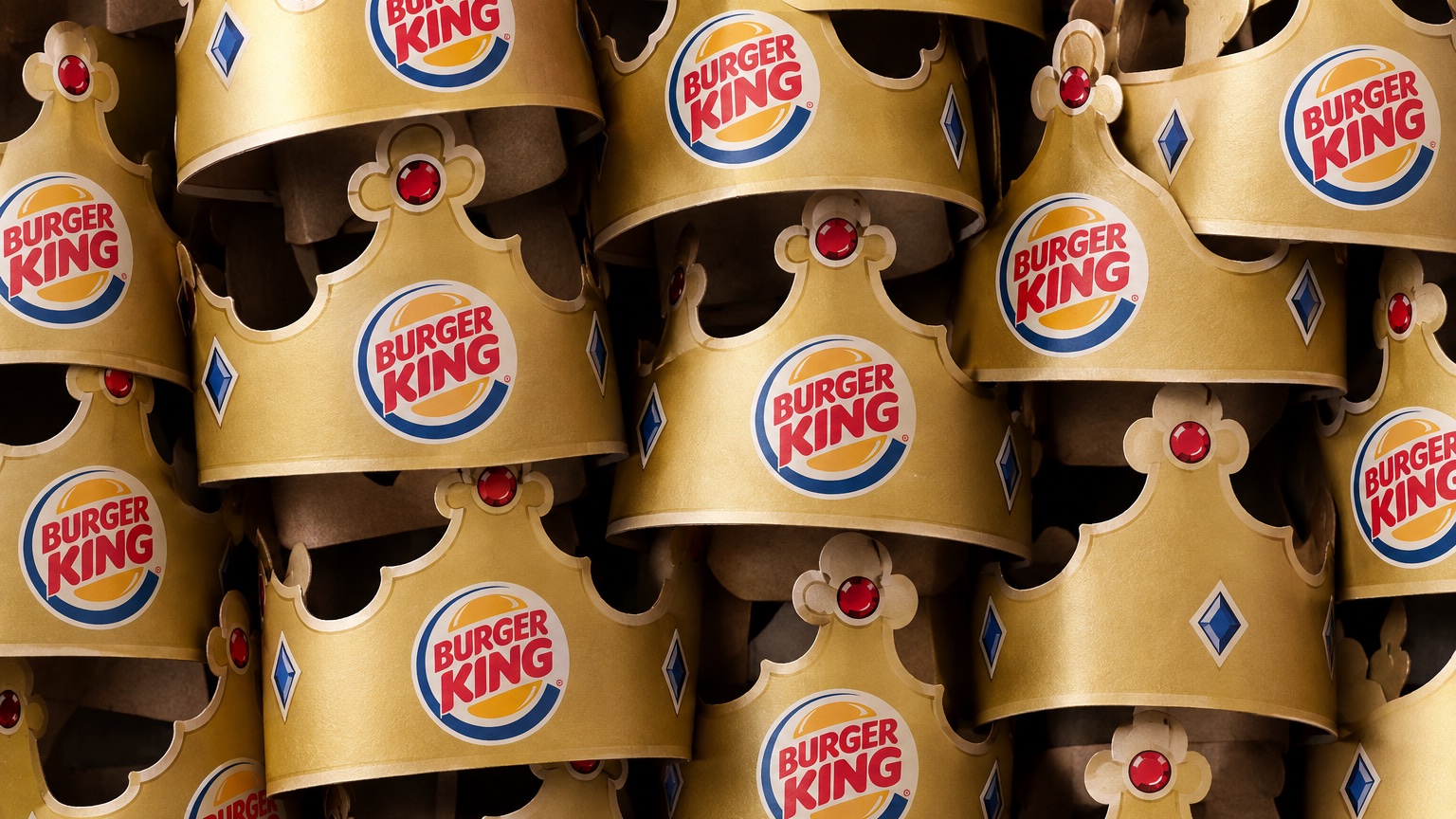
Wear your Burger King crown with pride
Sticking to our predictable human patterns, I’ve witnessed many seize upon this once-in-a-lifetime opportunity to launch their own automated business empires.
Like the mass-produced paper crowns Burger King used to give away, you may now anoint yourself CEO. Call your parents to let them know. Congratulations—you’ve made it.
Many apps now—Grok Bots, Dots—let you run an entire one-person enterprise. The first one-man company valued at over a billion dollars? That’s already happened, actually.
But just one thing. It’s just a bit too easy, isn’t it?
Cue a gigaflood of noise now entering the market. GitHub has already been falling apart with upload volumes this year, as everyone desperately tries to launch their own visionary app, to grab attention with automated marketing, market research, outreach bots.
“Please, whatever it takes, just help me escape the permanent underclass. Make no mistakes.”
— you, probably.
It’s ok, they can have their fun. They’ll soon find that there’s just not enough traction or demand in this world to keep their fledgling commercial business afloat.
Yes, you can absolutely build it, they just won’t come. And if it’s really valuable, they’ll point an LLM at it and build their own. Unfortunately, that’s already the reality we find ourselves in.
It may be time for humans to throw in the towel. Within the next few years, we’ll begin to see the idea of human-run organisations just not making that much sense anymore. I’m sorry for your loss.
Refactoring everything
A side effect of our current predicament is that gradually, and then rapidly, the systems we used to run our lives will begin to redesign themselves and become much faster, more fair, much more efficient.
I used to think that AI would meaningfully start running the world when it became obviously better than humans at all (or at least most) tasks. Once upon a time they called this ‘AGI’, and we’re not quite there yet.
But watching how it’s already impacting the world, I now think the days of AI running the show will arrive a little sooner, perhaps ahead of AGI.
Here’s a few examples of why:
- In London, it now takes around five years to argue your case before an employment tribunal. Why the sudden jump? Of course, AI has been used to flood the court system with every possible minor grievance.
- The job search is fundamentally broken. Anyone who’s been job hunting in 2026 knows this, hearing stories or reading viral posts about applicants secretly adding hidden 1pt white prompt injection text to their resumes. One modern solution, Jack and Jill, has been turning the whole two-sided marketplace into an AI vs AI adversarial battle for employment.
- Online dating, famously another kind of marketplace, has also been showing signs of degradation. Some users are deploying AI to game the system and the signal-to-noise ratio is lost in a world of AI-generated profile pictures and automated messaging. Perhaps positively, this is sending people heading back offline and into the real world.
The big picture behind all of these is that these are major tensions, surfacing today, which AI has either created or exacerbated. To the point where the only solution remaining is to use even more AI, i.e. to fight fire with fire.
My own remortgage took 2 and a half years to complete. There were never any snags and nothing was contested. It should have been completed in milliseconds. But the Land Registry was suffering a large backlog of cases due to Covid-19, and so officially the apartment I’d been living in for years didn’t exist yet. There are many such cases.
Therefore, the AI will insist upon itself. And as it redesigns some of these systems, incredible pressures will begin to mount on others. The LLMs’ inexhaustible supply of knowledge labour has met some very high historically pent-up demand. So the pressure has moved further down the chain and it’s now infeasible that this will ever be resolved without using more AI to fix the issue. In this way, it seems that everything will cascadingly collapse into the valley of full automation.
The next side effect I want to write about is going to be even stranger. I suspect it may be even harder to handle than the end of work.
The end of money
Spend your shells now
Many people have been bleating about Universal Basic Income for decades now. We’ve even run a few large-scale trials to see what happens.
It’s a nice idea, and I suspect that UBI probably will come into existence, at least for a short time. But, beyond this, I suspect something even stranger may begin to take place. The idea of money itself may begin to rot.
We need to remember that, despite how central it seems to everything in our lives, money is really just an idea that we’ve collectively subscribed to. It also has the unique quality that it’s mathematically infinite. Because of this, amassing wealth becomes a game that humans have been playing since forever. Nobody can ever win, as there can always be a new wealthiest person.
Money is a powerful idea. A status indicator. It doesn’t need to be notes or coins, it can be literally anything that we elect as a proxy for value. Only relatively recently, we discovered tribes in the Highlands of Papua New Guinea which still traded shells.
The Australians figured this out and were able to supply the shells by the planeload in exchange for access to their natural resources. Soon, the shells became nearly worthless. What’s scary is that we may genuinely find ourselves in their shoes some day soon. Our coins, our notes—our bank balances.
How can this be?
Because Musk’s oft-stated vision of hyperabundance may really come to pass. As our systems rapidly redesign and automate themselves, the cost of doing business across the board is going to fall.
We’ll start to see a flood of automated competition appearing in any commercial areas that are still uncompetitive, depressing prices to near-unthinkable lows.
So why use money anymore? What you need will be available to you for very low cost or for free. In an age of hyperabundance, money stops having much use, as it was only ever a useful proxy for something of value to us. A means to an end, not an end in itself.
We may no longer need such a proxy.
Like the Zimbabwean dollar, if you’re a legacy wealthy holdout and still cling to the idea of money, you may be able to command extreme volumes of wealth. But, paradoxically, it will begin to account for very little once the society you operate within ceases to care about money all that much. It thus becomes an antiquated idea. Insisting upon the importance of financial wealth might just make you sound like a bewildered, outmoded crank.
What a wild plot twist that might be. It might be time to put your wealth to work while it can still achieve something lasting.
What remains
Removing money does not delete the idea of value. Just because knowledge work is essentially free, it doesn’t mean that everything is now worthless.
Indeed, money could still be incredibly useful for many cases where robotics and knowledge automation still cannot solve an underlying demand vs supply problem. Those cases where things still retain their innate value, or supply is inherently limited:
- Rare materials and mineral rights. AI and robots cannot increase the amount of gold, titanium or other such resources in the Earth’s crust.
- Perhaps, land ownership. Although I could potentially see that becoming nationalised by popular demand. Why, realistically, would anyone want to own enormous tracts of land if it’s no longer turning them a handsome profit?
- Rare, high-value genetics, i.e. hot people. These will still have inherent social value, at least until the sexbots and commercial genetic editing arrive. Then we’re in that awful Bruce Willis movie, Surrogates, I guess.
- Social skills. Being a genuinely nice, likeable person who is well-embedded within their community. If anything, the value of this will probably rise, and it’s meant to help increase your lifespan, too.
Outro
The above is not meant to be a complete list or vision. What I’ve posited here is a very hand-wavy hot take, based on a rapidly developing situation.
Reality rarely unfolds according to a complete vision; normally some version of every scenario tends to co-exist at any moment in time. Even if I’m perfectly right, we can quote William Gibson:
The future is already here—it’s just not evenly distributed.
In a world without jobs, organisations or money, it may be hard for us to figure out what to do with ourselves. Please see my other post for some ideas: What Comes Next?
As for me, I’ve taken up rowing and bought a puppy. Because the pursuit of a meaningful and fulfilling existence must go on, even if the rules have changed.